



How to Scale Your Business with Digital Systems
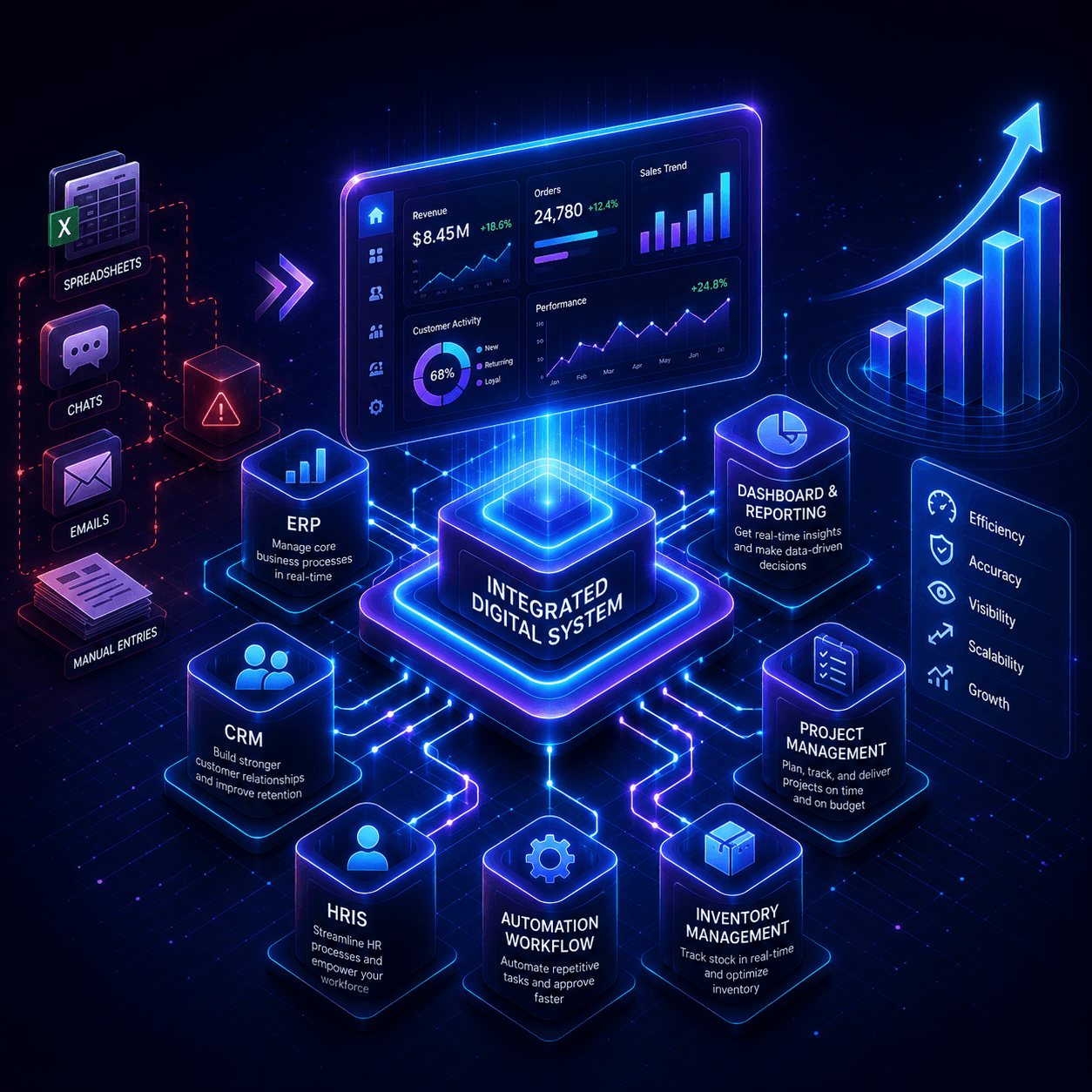
Many businesses successfully increase their sales, but not all are prepared to handle the operational growth that comes with it. As a business expands, operational processes become more complex — from internal workflows and team coordination to data monitoring and customer experience management.
Without the right system, business growth can create operational bottlenecks, human errors, communication issues, and inefficient workflows.
This is why digital systems have become one of the most important foundations for businesses that want to scale efficiently and sustainably.
What Is a Digital System in Business?
A digital system refers to the use of technology to manage, automate, and optimize business processes so they become more efficient, measurable, and integrated.
Some examples of digital systems commonly used by businesses include:
- ERP (Enterprise Resource Planning)
- CRM (Customer Relationship Management)
- HRIS (Human Resource Information System)
- Project Management Systems
- Workflow Automation Systems
- Dashboard & Reporting Systems
- Inventory Management Systems
The main goal is to make business operations faster, more organized, and more scalable.
Why Businesses Struggle to Scale Without Digital Systems
Many companies still rely on manual operational processes using spreadsheets, messaging apps, and disconnected tools.
While this may work during the early stages of a business, manual processes often become a bottleneck as customer numbers, transactions, and teams grow.
Common operational challenges include:
- Scattered business data
- Slow approval processes
- Increasing human errors
- Difficulty monitoring business performance
- Poor interdepartmental communication
- Too much repetitive manual work
As a result, businesses struggle to scale efficiently.
1. Improve Operational Efficiency
One of the biggest advantages of implementing digital systems is improved operational efficiency.
With integrated systems:
- Workflows become faster
- Manual tasks are reduced
- Processes become more structured
- Information is easier to access
For example, approvals that were previously handled through emails or chat applications can be automated through a centralized dashboard system, making the process faster and more organized.
2. Reduce Human Errors
As businesses grow, operational risks also increase.
Data entry mistakes, duplicate records, missed follow-ups, and inaccurate reporting can significantly impact business performance.
Digital systems help minimize human errors through:
- Automation
- Data validation
- Integrated databases
- Real-time tracking
With more systematic processes, business operations become more consistent and reliable.
3. Simplify Monitoring and Decision-Making
Business owners need fast and accurate data to make strategic decisions.
Through digital dashboards and reporting systems, companies can monitor:
- Sales performance
- Project progress
- Team productivity
- Daily operations
- Customer activities
in real time.
This allows management teams to make faster and more data-driven decisions.
4. Scale Operations Without Significantly Increasing Headcount
One of the biggest challenges during business growth is handling increasing operational workloads.
Without digital systems, companies often need to continuously hire more employees to support operational demands.
By implementing workflow automation and integrated systems, repetitive tasks can be automated, allowing teams to focus more on strategic work.
This enables businesses to scale more efficiently without dramatically increasing operational costs.
5. Improve Customer Experience
Today’s customers expect fast, seamless, and responsive services.
Digital systems help improve customer experience through:
- Faster response times
- Better customer tracking
- Integrated communication
- Automated follow-ups
- Data-driven personalization
The better the internal operations, the better the customer experience.
6. Build a Strong Foundation for Growth
Many businesses experience operational chaos as they grow because their internal systems are not prepared for expansion.
With digital systems, companies can build stronger operational foundations to support long-term business growth.
Businesses become:
- More scalable
- More adaptive
- More measurable
- Better prepared for increasing demand
Strategies to Start Business Digitalization
Digital transformation does not need to be large or complex from the beginning. Businesses can start gradually.
Some practical steps include:
- Identify the most time-consuming operational processes
- Find bottlenecks within business workflows
- Determine which systems are most needed
- Start automating repetitive processes
- Ensure systems can integrate across departments
Most importantly, digitalization should focus on improving business efficiency — not simply following technology trends.
Conclusion
Scaling a business is not only about increasing revenue, but also ensuring that operational processes can grow efficiently and sustainably.
Digital systems help businesses reduce manual work, improve efficiency, simplify monitoring, and create stronger operational foundations.
In today’s competitive business environment, companies that successfully integrate technology into their operations have a greater opportunity to grow faster and stay competitive.
If your business is starting to face operational challenges as it grows, this may be the right time to consider a more structured digital transformation strategy.
Noohtify has experience helping businesses transform manual operational workflows into efficient, scalable, and integrated digital systems. From internal system development and workflow automation to dashboard monitoring and business process digitalization, Noohtify helps companies build stronger operational foundations for sustainable growth.
SHARE
SUBSCRIBE
Subscribe to our newsletter & articles.